
Memory, accessibility and edutainment: the integrated project developed for the Accascina Museum of Messina
The Messina Earthquake Museum project was launched in 2023 with the permanent exhibition 1908 CittàMuseoCittà at the Regional Museum Maria Accascina. The immersive experience, developed by our Group and curated by the then Museum Director Orazio Micali, with the support of the institute’s scientific team, represents a pioneering laboratory in the field of digital heritage and participatory museology.
It is a highly innovative solution that combines physical and digital data through contemporary languages: on the one hand, hundreds of architectural and sculptural artifacts; on the other, images, maps, surveys, and multimedia reconstructions that recompose – within an immersive environment – the urban and social fabric of pre-earthquake Messina.
The immersive experience
The experience is highly engaging and structured into three main moments.
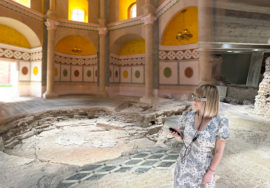
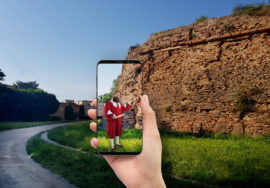
The first consists of an Augmented Reality path, where users are invited to frame selected landmark objects using smartglasses, gaining access to spectacular 3D reconstructions of pre-earthquake Messina. These reconstructions, faithful to the city’s original appearance, were created in collaboration with Messina-based architect Luciano Giannone, based on rigorous documentary research conducted by the Museum.
The second moment takes place in a dedicated room where visitors can explore a 3D digital twin of the vanished city and experience the moments immediately before and after the catastrophic earthquake – an event so powerful that it led Mercalli to add an extra degree to his seismic scale.
The third and final moment unfolds in a space defined by a striking sculptural installation, surrounded by screens displaying iconic locations of the city before and after the destruction. This solution invites visitors to reflect deeply on the fragility of life and the far-reaching consequences of the cataclysm.
“The project – explains Maria Mercurio, Director of the Accascina Museum – transforms the reconstruction of material and digital data related to Messina destroyed in 1908 into a collective and immersive narrative. Through a combination of archival research involving our entire curatorial staff, 3D modeling, Augmented Reality, and immersive environments, the project returns to the community a shared heritage of knowledge, images, and testimonies, paving the way for a new understanding of cultural memory as a common good. The public has welcomed this innovation with great interest. Citizens of Messina, as well as many schools, have visited the new exhibition in large numbers, finding in it a way to reconnect with a painful and often removed past, while fostering a more conscious reflection on the future.”
The following stages of the project
In 2024, the experience was extended to the Museum’s permanent collection, connecting artworks salvaged from the earthquake’s destruction – including absolute masterpieces by Caravaggio and Antonello da Messina – to the lost city and their original locations.
The Augmented Reality narratives, designed to ensure universal and multisensory accessibility, now allow visitors to engage with the collection through a deeply immersive experience.
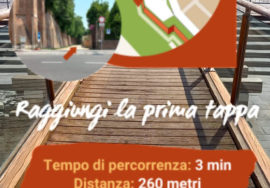
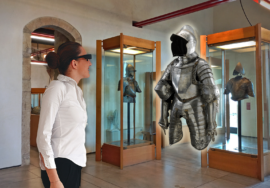
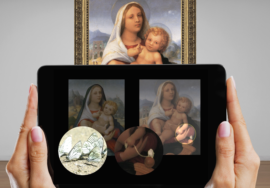
This approach took shape through the development of an immersive AR WebApp, accessible by scanning QR codes distributed along the exhibition path, as well as through the creation of an Augmented Reality tour using smartglasses, enabling close exploration of key artifacts and paintings in the collection. Digital reconstructions, dynamic infographics, and pictorial analyses enhanced with AR overlays provide a layered and interactive vision of the city’s cultural heritage.
In 2025, the project was further expanded with a didactic and sensory experience designed for a broad audience. By entering an interactive classroom, visitors can explore the city’s key sites through a diachronic perspective, comparing past and present using 3D models and multimedia data.
In 2026, the project will come full circle with the creation of a participatory platform that, through crowdsourcing processes and civic engagement, will collect new information and testimonies from the local community. The resulting data, made available in open format, will enrich the existing heritage and be shared with the Ministry of Culture’s Digital Library, becoming a common good and a shared resource.
In this way, the museum ecosystem dedicated to the 1908 Messina Earthquake continues to grow, in line with the philosophy already expressed in the title of the original 2023 exhibition. A museum that goes far beyond its primary conservation function, stimulating collective memory and active civic participation, restoring identity, and transforming itself into a living cultural device.
“Museums are places of citizenship and social innovation – adds Antonio Scuderi, CEO of Capitale Cultura Group and ARtGlass – At a time when new Generative Artificial Intelligence technologies confront us with major challenges – between new forms of participation and risks of cultural homogenization – projects like this are essential. They select new datasets of shared knowledge, tell previously untold stories, engage local communities, channel the power of digital platforms toward reflection, and create new professions and skills.”
For this project, Capitale Cultura Group was awarded the Premio Aretè 2025, in the Reginae Art & Culture Design category, at Bocconi University last October.